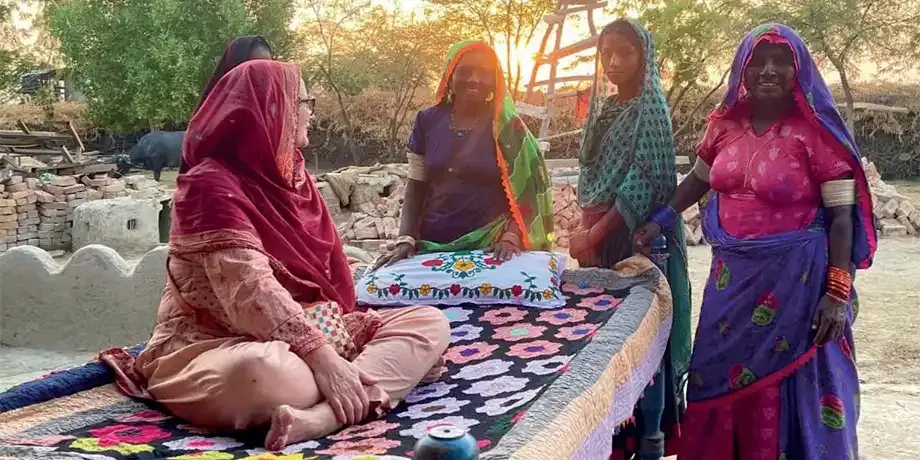
Women and the charpal
As hundreds of international catholic environmental advocates and faith leaders headed to Belem, Brazil, for the annual UNFCCC COP meeting (COP30) I was headed to Pakistan. It felt a bit counterintuitive to be headed away from this significant climate change summit as it marked the 10th anniversary of both the Paris Agreement and the release of Laudato Si’. The global Church had been organizing for well over a year to prepare for a robust presence in Belem. Columban missionaries have been engaged in these climate change summits continuously since their origin in Rio de Janeiro in 1992. Why would I choose to be anywhere other than Brazil?
It is precisely for these reasons that I felt confident in my decision to Belem and Brick Kilns Creation Spirituality by Amy Woolam Echeverria visit Pakistan at that exact same time. Having seen over the decades the slow but steady growth in the Church’s taking up of care for the earth and multilateral government negotiations through the U.N., I could see how clear our collective voice has become in calling for key commitments like: a just transition from fossil fuels to sustainable energy; finance for mitigation and adaptation to climate catastrophes; and the recognition of environmental debt owed by industrialized nations to nations gripped with financial poverty, climate violence, and migration. The Holy See delegation had a vocal and visible presence in Belem along with several Bishops from the Global South, and numerous catholic institutions and religious orders. I felt my efforts were better served by going to Pakistan to bear witness to the reality of life there, especially through the lens of the cry of the earth and the cry of its most vulnerable people.
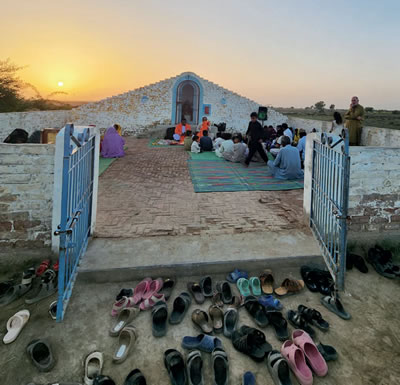
Having heard many stories by Columban missionaries in Pakistan, I anticipated deep economic poverty, fragile yet harsh landscapes, and a kind of pervasive violence that comes with systemic injustice. Some things I did not anticipate were the grace and dignity of the women in the village who carried clay water pots on their heads as they floated along the canals, the colorful and intricately painted trucks that moved people and goods from place to place on highways and roadways pocked with gaping holes, and the warm and curious faces of the children who eagerly ran to meet me in the villages to proudly show off their knowledge of the English language. Celebrating Mass in the village at sunset with goat and sheep milling about and by the light of a single cell phone flashlight under the stars all brought me closer to biblical scenes like the Nativity or the road to Emmaus in a way that reading the stories a thousand times never could.
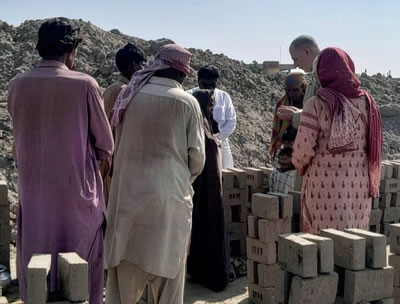
All the while I was there, I felt the urgency of COP 30. For example, one day we visited a typical brick-making kiln that is largely worked by Christian Pakistanis, who are considered unclean and the lowest of the low in society. The work is hard, messy, and exhausting. A typical family of grandparents, parents and children, perhaps 6-7 in total, working eight hours a day combined might make $3 USD. This means that children are not in school and that grandparents are working well beyond what their bodies can endure. When the heavy rains flood the fields, the kiln is closed because they cannot keep the ovens fired when the ground is submerged. As storms and flooding increase due to climate breakdown, families are out of work for longer and forced to go deeper in debt to their employers and landowners.
The day we visited the brick kiln, there was a young girl of about ten or twelve years old. She was sick and could not work. The family could not send her to the doctor because they could not leave work and even if they could, they had no money to pay for transportation, the doctor’s visit, or medicines. The family asked for a prayer and blessing from the Columban priest who was with me. As we gathered around her, all the Biblical stories of unjust landlords and healing the sick took on new depth for me.
It can feel despairing when governments haggle endlessly over the wording of different targets and commitments. It can feel enraging when industries like fossil fuels spend billions on lobbying to ensure their interests are protected. It is true that reforms are desperately needed at these U.N. summits. It is true that they are never ambitious enough to protect biodiversity and human life. It is true that if we were to disengage from the process, then any hope for the family working the brick kiln in Pakistan to rise above their oppression would dissolve as quickly as the mud in a typhoon.
As we turn our gaze to the environmental advocacy landscape in 2026, the UN Biodiversity Summit (COP17) in October in Armenia begs our attention. Just as Catholics have now robustly taken up the UN Climate Change summits, we need to encourage the Church to engage in the Biodiversity Summits. This year, countries at COP17 are expected to update their national plans of action to protect and restore biodiversity. It is a year of accountability.
If you are interested in learning more, visit the Convention on Biological Diversity’s website and look up who the representatives are for your country’s delegation and contact them with your advocacy concerns and asks, including holding them accountable to their progress in implementing the national blueprint. Urging bishops and other church leaders to speak out in support of care for the earth, as was done at COP 30, From Belém, a global synodal voice for ecological conversion —CIDSE, is another important way to lift our voices.
Finally, in December 2025, we shared highlights of joy and celebration over the past year, as well as some of the challenges we continue to face. As I listened to people, I was inspired by the way our Justice, Peace, Integrity of Creation (JPIC) and Interreligious Dialogue (IRD) team members are bringing the mission priorities to life in their local, national, and international contexts. I heard stories of creativity, integration, ongoing ecological conversion, and deepening of creation spirituality. I heard renewed energy, hope, and desire to try new approaches in engaging young people, families, and policymakers.
I want to thank the Columban missionaries in Pakistan for their warm hospitality and the invitation to serve as their annual retreat guide. The focus was on creation spirituality, which offered a powerful framework to explore spiritual principles like communion, willingness, and listening, along with spiritual movements, including from ego to ego, from fear to freedom, and from knowledge to Mystery.
Thank you to all involved in JPIC and IRD. May the Spirit continue to nurture and guide our commitment to care for people on the move and the earth.
Amy Woolam Echeverria is the Society’s international JPIC coordinator; she lives in the U.S.
