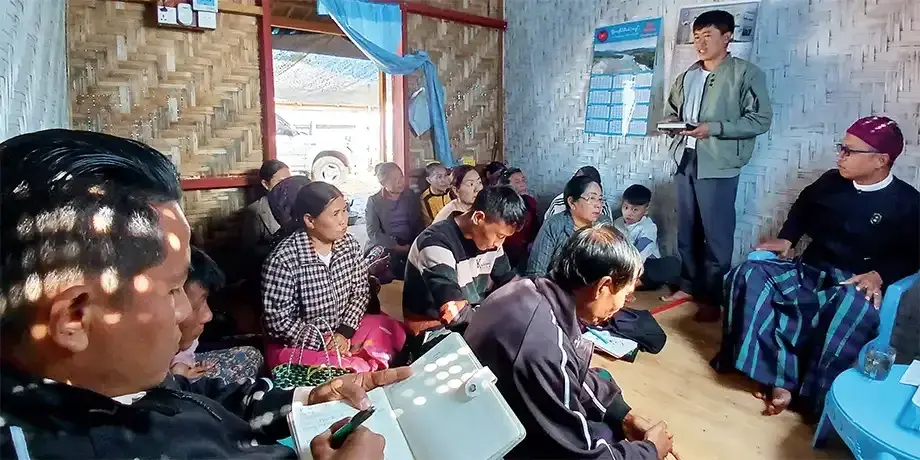
In the midst of their constant struggle for justice and peace, the Kachin people never cease to amaze me with their faith, not only in the way they practice it through words, but also especially through actions. At the Columban Central House, we receive many event invitations each week. Most of these are prayer services for birthdays, wedding ceremonies, funerals, various anniversaries, and thanksgiving. Yes, they hold a prayer service for any life event, and they invite most Catholics to pray and celebrate with them.
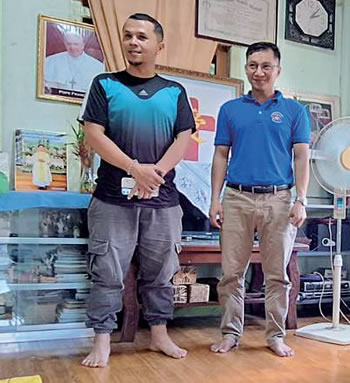
Apart from these events, there are also prayer services held in every household in the community. These are usually conducted by four different groups at different times every Sunday. These groups are the Nawku hpung (church group), a group of young and adults together; the Kawa La hpung (fathers’ association); the Num hpung (mothers’ association); and the Ramma hpung (youth group). This tradition of house-to-house prayer began with just one group. However, the large number of people who joined made it impossible to visit every household in the community. So, they decided to split into four groups. In the Philippines, it is quite similar to our Basic Ecclesial Community (BEC), where prayer services are held in different houses.
Having been invited by these groups and having participated in their services, I noticed a particular order or steps they follow. First, the Catechist announces the names of the host families in each group before the Eucharistic celebration ends, so the faithful know which household to go to. When they are gathered in their respective places, the Catechist asks the head of the family to write or say their prayer intentions, most of which are for thanksgiving, prosperity, good health for each family member, and peace. Then, basic prayers are said, followed by worship songs and the reading of the Gospel, or any other readings for the day. Someone then shares their reflection on the reading.
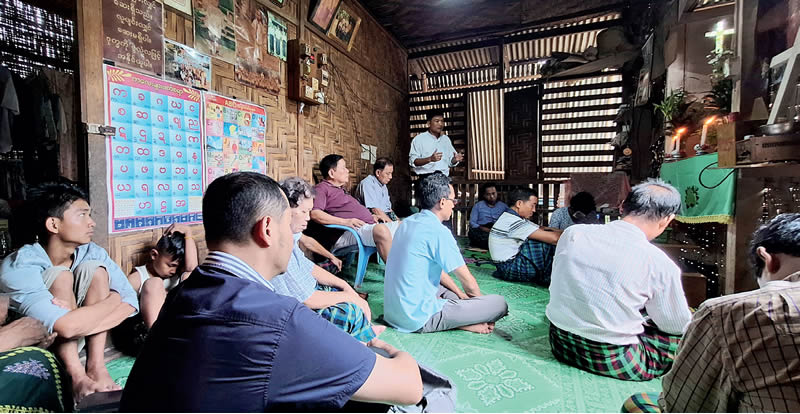
Sometimes they would ask me to share my own reflection, drawing on my personal experience. As I am not very fluent in their local language, someone would translate some of the English words I used so they could understand the message I intended to convey. The Catechist will now offer the prayer intentions of the host family, followed by the praying of the Holy Rosary and the singing of songs for the offertory. It ends with a final prayer and a prayer to the guardian angel. The whole service usually takes an hour or less. It is common for the visitors to stay for a while to share snacks or a meal prepared by the host family. At this point, something wonderful can be observed. With the help of some neighbors, food will be prepared in the kitchen. The mother usually cooks the food while the children are tasked with serving the food to the visitors.
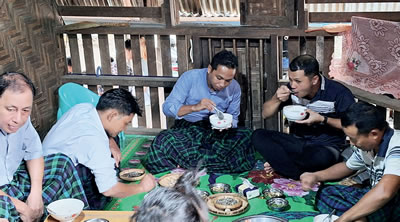
Thus, the prayer service is not just a way to connect with God but also a way to connect with one another, particularly with those who don’t attend church regularly for whatever reason. Here, no one is discriminated against. The leader would ensure that everyone is invited and informed in advance, whether or not they attend Mass regularly.
This communal celebration can also be observed during major parish celebrations, where everyone partakes of the food prepared, regardless of one’s status in the community and in the church. Despite the uncertainty brought by the ongoing internal conflict, the people remain faithful to God, to the Church, and to one another. They truly enriched my faith. Working as a lay missionary in this Kachin land, I feel truly blessed.
May their prayers be heard and answered by our Creator, through Jesus Christ and Mary!
Michael Javier is a Columban lay missionary from the Philippines. He currently lives and works in Myanmar.
