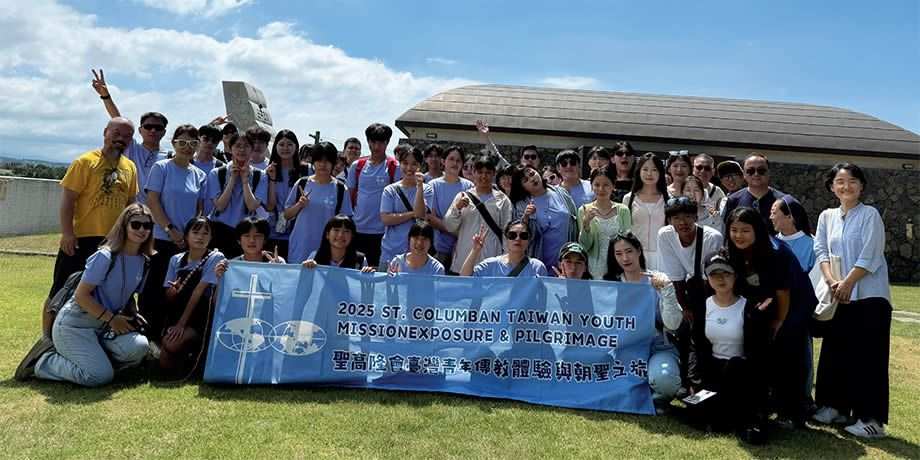
In July 2025, the humid air of Jeju Island carried more than just the scent of the sea; it carried the prayers and laughter of twenty-four young people from Taiwan.
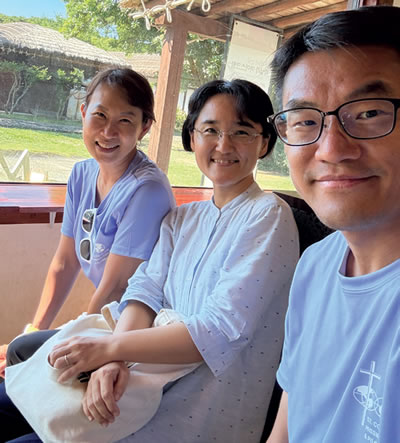
This five-day journey was not a mere vacation, but a meticulously planned Society Invitation to Mission (SIM) program, a signature initiative led by our Columban lay missionary (CLM), Bae Sihyeon. As a priest serving alongside her, I found immense joy in this collaboration. Our partnership was a living testament to the Synodal spirit—ordained and laity walking, planning, and praying together as one missionary body.
We began our journey at the Blessed Felix Kim Gi-ryang Martyr Memorial. Felix, the first to bring the Catholic faith to Jeju, occupies a quiet corner of history, and his memorial is humble. Initially, I worried the youth might find it underwhelming compared to Jeju’s famous scenic landmarks. I was wrong.
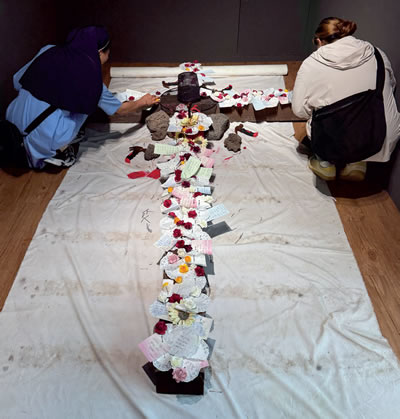
The turning point came during a simple activity: the youth were invited to write their deepest burdens and prayers on slips of paper and physically hammer a nail into a large wooden cross. The rhythmic, heavy “thwack” of hammers against wood replaced the usual chatter of teenagers. I watched as tears welled up in their eyes. In that small room, the abstract concept of “martyrdom” became a physical reality. They weren’t just looking at history; they were nailing their own lives to the Cross of Christ. This was the exact moment they ceased being “tourists” and became “pilgrims.”
The mission exposure was profoundly enriched by an unexpected tapestry of international solidarity. While we were there to learn about the Columban legacy, the Holy Spirit expanded our boundaries. We were joined by Hongseok, a Korean Columban preparing for his mission in Taiwan, providing a bridge between the youth’s home and their host island.
However, the most moving encounter was facilitated by Fr. Peter Dong, the first Chinese Columban priest who was working in Korea. He brought together a group that truly represented the “Church without borders.” This group included not only Chinese youth living in Korea but also a special delegation from mainland China, featuring two priests and one religious sister.
To see youth from Taiwan, Korea, and mainland China—territories often divided by complex politics—breaking bread and singing hymns together was a miracle of grace. We sat together in the shadows of the volcanic Oreums, discussing our shared faith. This encounter was a powerful spiritual preparation for World Youth Day 2027 in Seoul, proving that the missionary call of the baptized is a shared responsibility that transcends every human border.
Our itinerary led us to the St. Isidore Farm. There, the youth saw how faith takes flesh in social and economic development. We reflected on how the Columban pioneers didn’t just build churches; they built communities and dignity.
We also visited the Jeju 4.3 Peace Park. It was a somber lesson in the necessity of social justice. The youth stood before the monuments of the fallen, reflecting on the Church’s role as a healer in broken societies. Whether we were trekking through the woods or celebrating Mass on the basalt rocks of the shore, we practiced a “theology of the road.” The youth began to understand that mission is lived in the “ordinary moments”—in work, in family, and in the way we treat the environment.
As we boarded the flight back to Taiwan, the group was different. The initial “tourist excitement” had been replaced by a quiet, settled strength. These young people are now returning to their parishes not just as members, but as missionary disciples.
For me, this experience reaffirmed that the most effective mission is one where the ordained and laity work in true partnership. By honoring the Synodal path, we showed the youth that every baptized person has a seat at the table and a role in the mission. Through the SIM program, we didn’t just show them Jeju; we showed them the heartbeat of a Church that walks together.
Columban Fr. Seok Jinwook Antonio is from South Korea. He currently lives and works in Taiwan.
